【STUDY|Materials】Introduction to Materials (Acrylic Part 1)

Acrylic is also known as the “Queen of Plastics.
It has extremely high transparency, with a light transmission rate of 93%, making it a material that allows more light to pass through than glass.
It is also stronger than glass, with an impact resistance more than 10 times that of glass.
It also has weather resistance, so there is no problem even when used outdoors (except for deterioration over time).
It is a versatile material, as more and more acrylic materials are being used for 3D printers.
It can be bonded and bent, and is easy to cut. However, cutting results in a cloudy white surface, so post-treatment (buffing and burner polishing) is required to achieve a mirror-like (transparent) surface.
1. Manufacturing Methods
There are two general types of acrylic manufacturing methods.
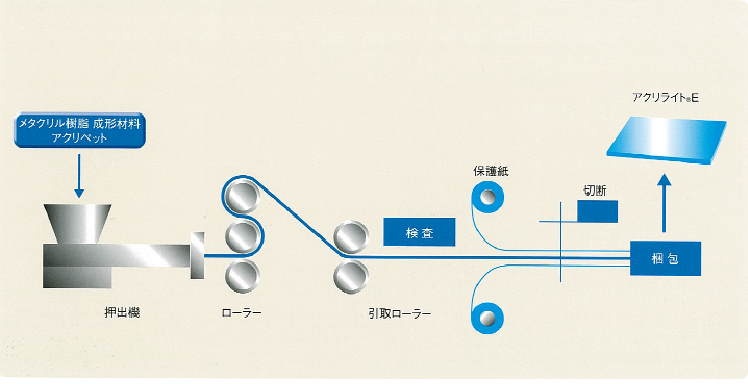
Extrusion: Acrylic raw materials are pushed between rollers to produce sheets.
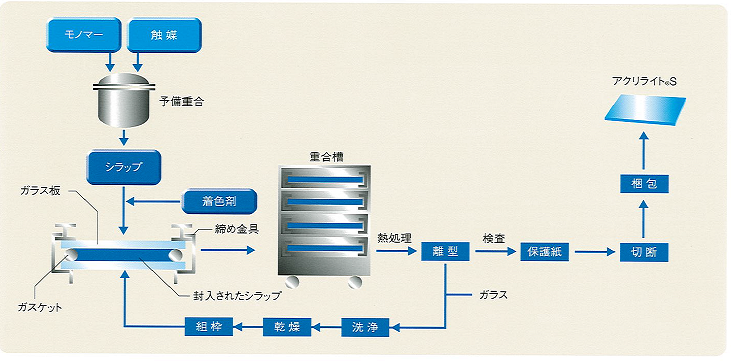
Casting: A process in which a rubber packing is placed between two glass plates and the acrylic material is filled into the rubber packing and polymerized.
| productivity | Productivity Small variety, but high productivity | Variety, but productivity is low |
| Processing (cutting) | ||
| Processing (gluing) | ||
| Bending | ||
| Thickness accuracy High Low | ||
| Standard size Many Few | ||
| Thickness size | Up to 20 mm at thickest | Thickness possible (up to 100 mm) |
| Color Variety | Small quantity | Large quantity |
| Price | Low | High |